
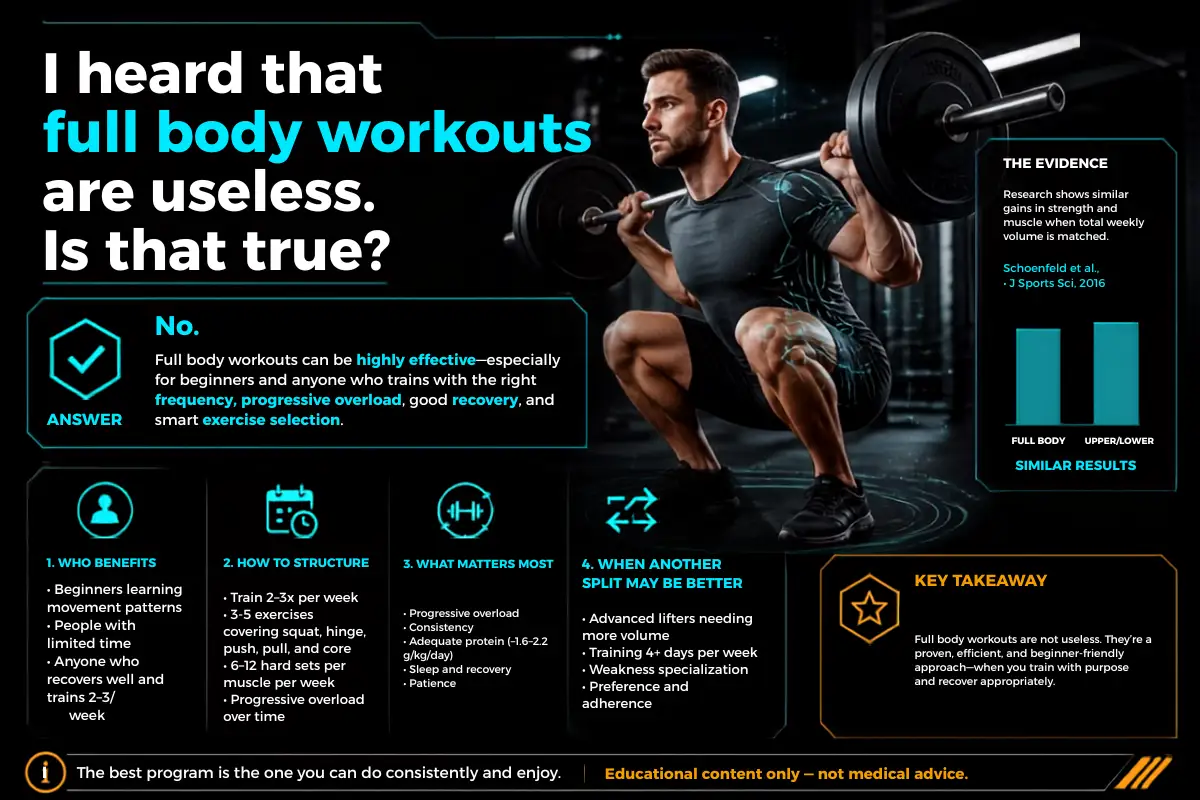
In the world of fitness, full body workouts often spark debate. Some people believe they are less effective than split routines that target specific muscle groups on different days. But is there any truth to this claim?
The answer is no. Full body workouts are far from useless. They can help build muscle, improve overall strength, support weight management, and save time.
In this article, we’ll explore how full body workouts work, address common misconceptions, discuss their benefits, and compare them with split routines. Whether you’re a beginner or an experienced lifter, understanding these workout styles can help you choose the right approach for your fitness goals.
Understanding Full Body Workouts
What Are Full Body Workouts?
Full body workouts are exercise routines that engage multiple major muscle groups during a single training session. Instead of focusing exclusively on one area, such as the chest or legs, these workouts target the entire body.
They typically include compound exercises that work several muscles simultaneously. Common examples include squats, deadlifts, push-ups, and rows.
The goal is to provide a balanced strength-training experience while making efficient use of your gym time.
What Does a Typical Full Body Workout Include?
A typical full body workout combines exercises that target different muscle groups.
For example, a workout might include:
- Squats or deadlifts for the lower body.
- Push-ups or bench presses for the chest.
- Rows for the back.
- Shoulder presses for the shoulders.
- Planks or other core exercises for abdominal strength.
- Isolation exercises for specific muscles, such as biceps and triceps.
Most people can perform full body workouts 2–3 times per week, allowing sufficient recovery between sessions.
Common Myths About Full Body Workouts
Several misconceptions make people question the effectiveness of full body training. Let’s look at some of the most common myths.
Myth 1: Full Body Workouts Don’t Build Muscle
One common misconception is that full body workouts cannot build muscle effectively.
This is simply not true. Full body workouts can stimulate muscle growth when combined with progressive overload, appropriate training intensity, and sufficient recovery.
Progressive overload involves gradually increasing the demands placed on your muscles, such as lifting heavier weights or performing more repetitions over time.
Myth 2: Full Body Workouts Are Only for Beginners
Although full body workouts are excellent for beginners, they are not limited to people who are new to fitness.
Intermediate and advanced lifters can also benefit from full body routines. They can help maintain strength, improve conditioning, and provide a flexible training approach during busy schedules.
The effectiveness of a workout depends on how well it is designed and adapted to an individual’s fitness level.
Myth 3: Full Body Workouts Don’t Provide Enough Cardio
Another misconception is that full body workouts cannot improve cardiovascular fitness.
However, full body training can include high-intensity movements, circuit training, and plyometric exercises that increase heart rate.
Combining strength exercises with cardiovascular movements can make workouts more challenging and improve overall fitness.
Benefits of Full Body Workouts
Full body workouts offer several advantages that make them a popular choice for people with different fitness goals.
1. Time Efficiency
One of the biggest advantages of full body workouts is that they save time.
Instead of dedicating separate gym sessions to individual muscle groups, you can train multiple areas in one session.
This approach is particularly useful for people with busy schedules who want to maintain a consistent exercise routine without spending hours at the gym.
2. Improved Overall Strength
Full body workouts help develop strength across multiple muscle groups.
Exercises such as squats, deadlifts, push-ups, and rows involve coordinated muscle movements that can improve functional strength.
This strength can support everyday activities, including lifting objects, carrying groceries, climbing stairs, and maintaining better physical performance.
3. Increased Calorie Expenditure
Full body workouts involve several muscle groups, which can increase energy expenditure during exercise.
Depending on workout intensity, duration, and exercise selection, they can support weight management and fat-loss goals.
Strength training can also contribute to post-exercise energy expenditure, known as excess post-exercise oxygen consumption (EPOC).
However, successful weight loss also depends on overall calorie balance, nutrition, and consistency.
Full Body Workouts vs. Split Routines
Both full body workouts and split routines can be effective strength-training approaches. The best choice depends on your schedule, training experience, and fitness goals.
What Are Split Workouts?
Split routines divide training sessions according to specific muscle groups.
For example:
- Monday: Chest and triceps.
- Tuesday: Back and biceps.
- Wednesday: Legs.
- Thursday: Shoulders.
- Friday: Core and additional muscle training.
This approach allows individuals to dedicate more exercises and training volume to specific muscle groups.
Pros and Cons of Full Body and Split Workouts
Full Body Workout Advantages:
- Saves time by training multiple muscle groups in one session.
- Provides a balanced approach to strength training.
- Allows frequent training of major muscle groups.
- Works well for people with limited gym availability.
Full Body Workout Disadvantages:
- Sessions can become tiring when too many exercises are included.
- Training volume for individual muscles may be more limited.
- Exercise selection and recovery need careful planning.
Split Workout Advantages:
- Allows more focused training for specific muscle groups.
- Provides opportunities for higher training volume.
- Makes it easier to organize specialized muscle-building programs.
Split Workout Disadvantages:
- May require more gym visits each week.
- Missing a session can disrupt the weekly training schedule.
- Can be less convenient for people with limited time.
Which Workout Is Better for Different Fitness Goals?
If your goal is to improve overall strength, maintain fitness, and save time, full body workouts can be an excellent option.
If you prefer focusing on individual muscle groups and have more time available for training, split routines may suit your preferences.
However, neither approach is automatically superior. Both can support muscle growth and strength development when properly programmed.
The most effective workout routine is one that matches your goals, recovery needs, and lifestyle.
Scientific Evidence Supporting Full Body Workouts
What Does Research Say About Their Effectiveness?
Research on resistance training suggests that full body workouts can be effective for improving muscular strength and promoting muscle hypertrophy.
Training each major muscle group multiple times per week can be a useful strategy for improving strength.
The effectiveness of a training program also depends on factors such as total training volume, intensity, frequency, and recovery.
Therefore, full body workouts should not be dismissed simply because they train several muscle groups in one session.
Fitness Experts’ Recommendations
Fitness guidelines commonly emphasize training all major muscle groups regularly.
Organizations such as the American College of Sports Medicine recommend incorporating resistance exercises for major muscle groups into a consistent weekly fitness routine.
Full body workouts can help individuals achieve this goal through structured and balanced training sessions.
Who Should Consider Full Body Workouts?
Full body training can be adapted to suit different fitness levels and lifestyles.
Beginners and Advanced Lifters
Beginners can benefit from full body workouts because they provide opportunities to learn basic exercises and develop balanced strength.
Advanced lifters can also incorporate full body training to maintain strength, improve conditioning, or add variety to their existing programs.
The key is adjusting exercise selection, intensity, and training volume according to experience.
People With Busy Schedules
People balancing work, family, and other responsibilities may find full body workouts particularly useful.
Training multiple muscle groups in one session makes it easier to maintain a consistent routine without needing to visit the gym every day.
People With Specific Fitness Goals
Full body workouts can be adjusted to support several goals, including:
- Weight Loss: Combining resistance training with appropriate nutrition can support fat loss.
- Muscle Building: Progressive overload and sufficient training volume can stimulate muscle growth.
- Improved Strength: Compound exercises develop strength across multiple muscle groups.
- General Fitness: Balanced training can improve overall physical performance.
Tips for Effective Full Body Workouts
To get the most out of your training sessions, focus on proper exercise selection, recovery, and consistent progress.
Choose the Right Exercises
Prioritize compound movements that engage multiple muscle groups.
Some effective exercises include:
- Squats.
- Deadlifts.
- Push-ups.
- Bench presses.
- Rows.
- Shoulder presses.
- Planks.
You can also include isolation exercises to target specific muscles when needed.
Maintain the Right Workout Frequency and Recovery
For many individuals, performing full body workouts 2–3 times per week is a practical starting point.
Allow enough recovery time between sessions, particularly after challenging workouts.
Recovery is important for muscle repair, strength development, and long-term progress.
Track Your Progress and Adjust Your Routine
Monitoring your progress can help you understand whether your training program is working.
Keep track of:
- Weights lifted.
- Number of repetitions.
- Number of sets.
- Workout frequency.
- Changes in exercise performance.
Gradually increase training demands when appropriate, and adjust your routine as your fitness level improves.
Conclusion: Are Full Body Workouts Truly Useless?
No, full body workouts are certainly not useless. They offer an effective and flexible approach to strength training that can benefit beginners, experienced lifters, and people with busy schedules.
They can help build muscle, improve overall strength, support weight management, and make exercise more time-efficient.
Although split routines offer opportunities for more focused muscle training, full body workouts remain a valuable option for achieving different fitness goals.
Ultimately, there is no single workout routine that works best for everyone. Choose a training approach that suits your lifestyle, allows proper recovery, and keeps you motivated.
Consistency, progressive overload, and proper exercise technique matter far more than whether you choose a full body workout or a split routine.
Frequently Asked Questions (FAQs)
How Often Should I Do Full Body Workouts?
Most people can perform full body workouts 2–3 times per week. This frequency allows them to train major muscle groups regularly while providing recovery time between sessions.
Can Full Body Workouts Help Me Lose Weight?
Yes. Full body workouts can support weight loss by increasing energy expenditure and helping maintain or build muscle. For effective weight management, combine exercise with balanced nutrition and an appropriate calorie deficit.
Are Full Body Workouts Suitable for Beginners?
Absolutely. Full body workouts are an excellent option for beginners because they help develop foundational strength, improve movement patterns, and train major muscle groups in a balanced way.
What Exercises Are Included in a Full Body Workout?
Common full body exercises include squats, deadlifts, push-ups, bench presses, rows, shoulder presses, and planks. These movements target multiple muscle groups during one training session.
Are Full Body Workouts Better Than Split Routines?
Neither approach is universally better. Full body workouts are convenient and time-efficient, while split routines allow more focused training of individual muscle groups. The right choice depends on your goals, schedule, and training preferences.
Published by: TEAM EP